Rain design
Rain as a design material
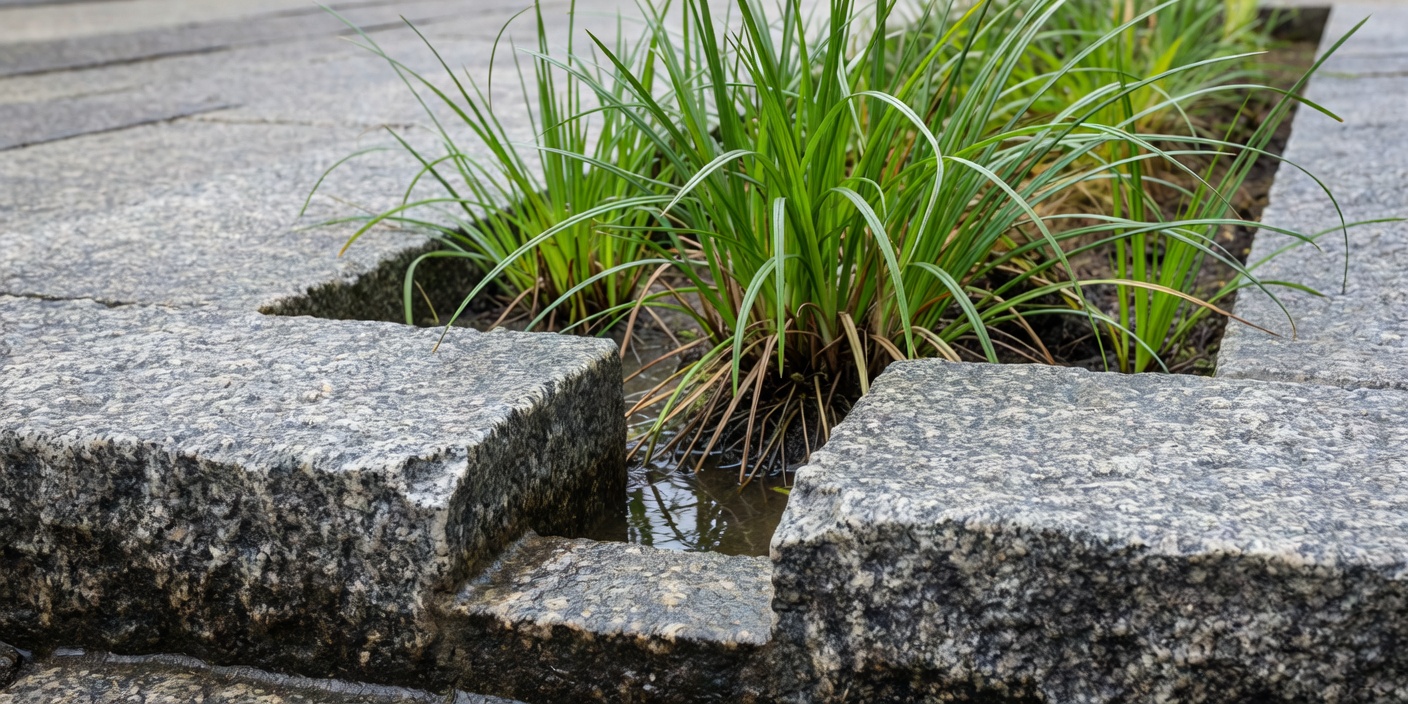
For a long time, the aim with rain in cities was simple: get it off the surface and into a pipe as fast as possible. A growing number of streets now do the opposite. They slow water down, let it soak into soil and give it to plants. The evidence is in kerb cuts, sunken beds and paving with open joints.
Why surface water became a design question
Roofs, roads and paved yards stop rain from soaking into the ground. Water runs off quickly, collects in low points and floods drains during heavy downpours. In older areas where rainwater and sewage share the same pipes, intense rain can overload the system, so that untreated water spills into rivers.
The response goes by several names. In the UK it is usually called sustainable drainage systems, or SuDS; elsewhere you may meet terms such as water-sensitive urban design, green infrastructure or the sponge city. The shared principle is to manage rain close to where it falls, using surfaces and landscape as well as pipes. The approach complements conventional drainage rather than replacing it.
A street-scale glossary
- Permeable paving
- Paving that lets water pass through joints or the material itself into a stone layer beneath, where it is stored and released slowly.
- Rain garden
- A planted bed set below the surrounding surface, collecting runoff and letting it soak away over hours rather than minutes.
- Swale
- A shallow, usually grassed or planted channel that carries water slowly along its length while some of it infiltrates.
- Kerb inlet
- A gap or cut in the kerb that lets road runoff flow sideways into a planted bed instead of into a gully.
- Tree pit with soil cells
- An underground structure supporting the pavement while leaving loose soil that roots can use and that can hold water.
- Rill
- A narrow open channel, often in stone or metal, that makes the path of water visible across a public space.
- Green roof
- A planted roof layer that absorbs some rainfall and delays the rest.
Following a drop of rain
A simple way to understand a scheme is to trace where water travels during a shower:
- Rain lands on a roof, road or footway and starts to move towards the lowest point.
- Kerbs, gentle falls in the paving or a rill guide it towards a planted area rather than a drain.
- A kerb inlet or a gap in an edging lets it enter the bed.
- Plants and soil slow it; some soaks into the ground, some is taken up by roots, some evaporates.
- In heavy rain, an overflow — often a raised grating within the bed — sends excess water into the conventional drain.
If any of these steps is blocked, the system behaves like an ordinary hard surface. Leaves across an inlet or a kerb set slightly too high can stop water ever reaching the plants.
Where it struggles
These techniques are not suited to every location. Clay soils drain slowly, so stored water may need a pipe outlet. Steep streets need checks and steps to stop water rushing through. Ground affected by past industry may be contaminated, in which case soaking water into it is unwise and lined systems are used instead. Underground cables and pipes limit how deep beds can go.
Maintenance is the most common weakness. Permeable paving joints can clog with silt and need periodic cleaning; rain gardens need litter removed, plants replaced and inlets kept clear. Responsibility can be split between highway, drainage and parks teams. Where a scheme looks neglected, the design idea may be sound while the upkeep arrangement is not. Local authority guidance on drainage and highways sets out what is expected in a given area, and it varies widely.
What to look for after a storm
- Water ponding briefly in a rain garden, then gone within hours rather than days.
- Kerb inlets free of leaves, litter and silt.
- Permeable paving drying evenly, without permanent puddles at low points.
- Plants that look healthy in both wet and dry spells.
- Footpaths beside beds staying usable, without water spilling across them.